Key Takeaways:
- Contextual Relevance: Contextual data matters more than global rankings for institutions seeking actual relevance.
- AI Consolidation: AI is becoming a stack decision within a few massive ecosystems like Microsoft, OpenAI, and Google.
- Vendor Presence: Oracle had a more limited presence at Alliance 26, potentially creating opportunities for other vendors to increase their visibility and engagement.
Last week, I had the pleasure of attending HEUG’s Alliance 2026 conference in Orlando, Florida. It was a milestone event for the ListEdTech team; marking our second year with a booth, my first time attending the conference, and my very first keynote presentation. The energy at the Orlando World Center Marriott was incredible, and the organizers did a phenomenal job hosting thousands of higher education professionals.
Modeling Reality, Not Intent
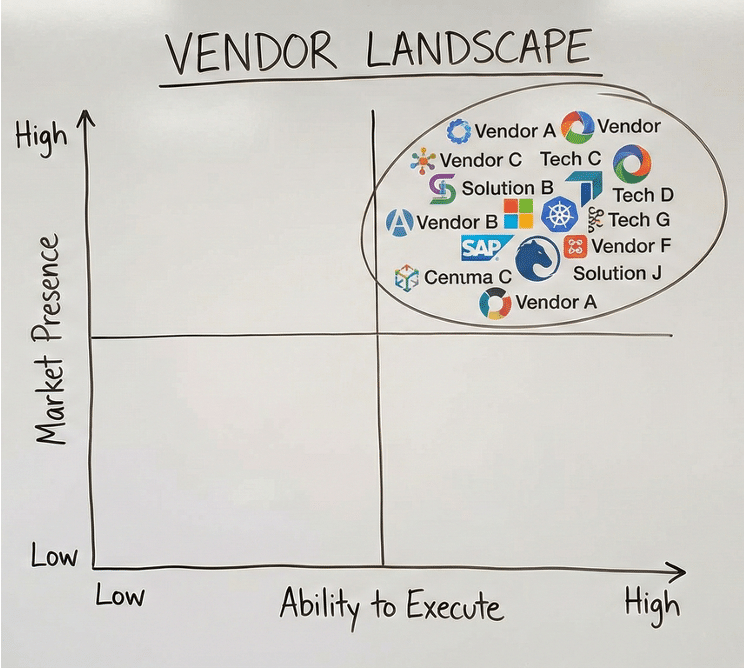
One of the highlights of the week was the opportunity to share our mission with such a dedicated crowd. My keynote, titled “Stop Guessing: Data-Backed Strategies for Critical Choices,” felt less like a standard data presentation and more like an intervention for decision-makers. I challenged the room to move past the “comfort” of traditional market quadrants, which have often become opaque marketing shortcuts rather than neutral analyses. I argued that these charts often hide peer relevance behind generic categories and fail to show actual implementation friction.
The core of my message was simple: “We don’t model intent. We model reality”. At ListEdTech, we rely on public evidence, like board meeting minutes and verified contracts, to see what is actually being used on campus today. A major “aha moment” for the audience was our deep dive into the concept that context beats consensus. Using the example of Populi, I showed how a company that looks like a niche player in a global view becomes a market leader when you filter the data specifically for small, private North American institutions. This reinforced the idea that peer relevance matters infinitely more than global rankings.
We also tackled the massive reality check regarding AI. Our data shows that higher education AI is consolidating at the platform layer rather than fragmenting. Most top vendors are not building their own foundational AI; instead, they are aligning with a few massive ecosystems like Microsoft, OpenAI, and Google. This means AI is no longer just a feature decision: it is a stack decision that impacts your institution’s governance, security, and faculty workflows for years to come.
The Missing Elephant in the Room
Beyond the stage, the discussions at our booth and in the halls were equally illuminating. A recurring theme was the future of PeopleSoft. Many institutional staff members I spoke with are beginning to grapple with the reality that they will likely need to change systems in the next decade or so. While some mentioned they hope to retire before that shift happens, others were eager to see which vendors their peers might be moving toward and if they would stay with Oracle.
There was also a palpable “elephant in the room,” or rather a missing one. Oracle’s presence was surprisingly small, with no booth on the floor. Many vendors and Oracle partners commented on this, noting how Oracle historically occupied the largest space at the conference. This led to a distinct feeling of abandonment among some long-time users, while other vendors like Workday were clearly present and circling, ready to fill that void.
The First of Many Partnerships
I am particularly proud that we have established a strong partnership with HEUG. They are the first association to sign up for our program, and all HEUG institution members now have access to a basic version of our portal. This allows them to see peer benchmarks in under three minutes, helping them make evidence-based decisions rather than “buying belief”. We are also excited to have similar agreements in place with 1EdTech and AACRAO.
It was a week of tough questions and honest data. As I told the crowd in Orlando: Stop guessing and start looking. Your institution’s success depends on it.