ListedTech
  • Data Portals
    • Portal for Industry
    • Portal for Institutions
    • Webinars
  • Product Categories & Reports
  • Resources
    • Blog
    • Podcast
    • Documentation
    • Webinars
  • About Us
    • Our Story
    • Data Overview
    • Traditional IT Research vs. ListEdTech
    • In the Media
    • Contact Us

Search the website...

Go to Portal
Posted on August 9, 2020 | by Justin Ménard

Evolution of Cloud Hosting in Education

Learning Management Systems Student Information Systems
Email, LMS and SIS Implementations - LisTedTECH

Over the past 20 years, the educational technology landscape has changed drastically: numerous educational institutions abandoned their homegrown solutions to select commercial options. During the same period, some of them have considered ditching their server rooms to the profit of cloud solutions. 

In January 2019, I wrote a post about Canadian institutions moving to the cloud. I had mentioned that some Canadian institutions were reluctant to select a cloud hosting solution because of the US Patriot Act. This is now in the past thanks to the hosting companies having web farms in several cities across Canada.

For this week’s post, I decided to give an update on the evolution of self-hosting and cloud-hosting in North America. As we can see below, since 2005, HigherEd institutions have started to use cloud hosting for their email solutions, then for their LMS and more recently for their SIS.

This decision was mostly vendor-driven. At first, Goggle and Microsoft, companies with large server capacities, offered “free” email services to their customers. Then, companies like Moddleroom and Instructure, which operates as a software as a service (SaaS) using mostly cloud web services, gained several new clients. This trend was then followed by cloud-only ERP solutions, like Workday.
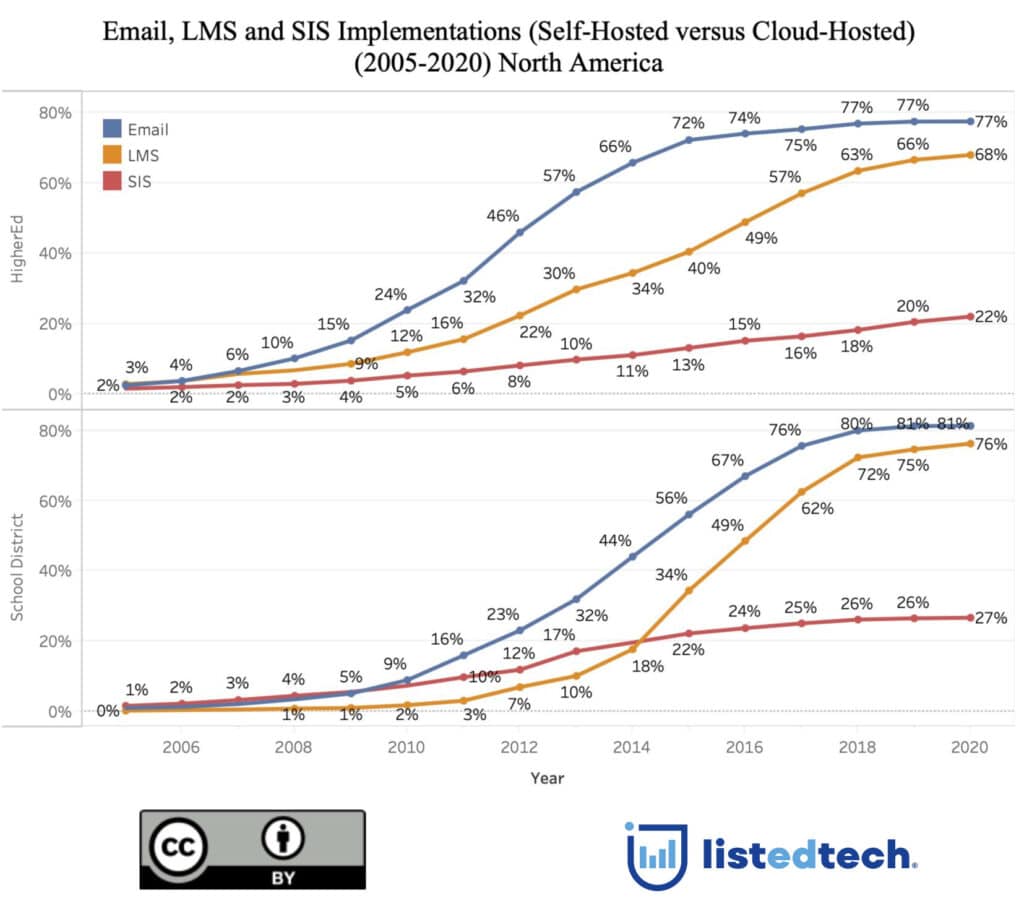
In the graph above, you can see the evolution of cloud hosting as a percentage of total active implementations. Note that school districts started the move to the cloud about two years after higher education but transitioned at a faster pace. They have now surpassed overall percentages when it comes to cloud hosting in the three categories selected (Email, Learning Management Systems, and Student Information Systems).

I believe that educational institutions are now at the tipping point of moving most of their systems to online servers. To support this reasoning, we can track the institutions’ decision to move their website to a cloud solution. In other words, if the cloud has proven to be cost-efficient (email), reliable (LMS), and secure (ERP), educational institutions will eventually decide to move “simpler” systems to the cloud, for example, their main website.

To prove our point, we pinged almost 47,000 websites (30,000 HigherEd and 17,000 school districts). We got different results based on the geographical location of the institutions: while we see that more than 35% of school district websites are hosted in the cloud, less than 5% of African and Asian HigherEd institution websites have migrated to the sky. With the almost daily power outages in some regions of the world, a cloud solution may be proven beneficial to them.
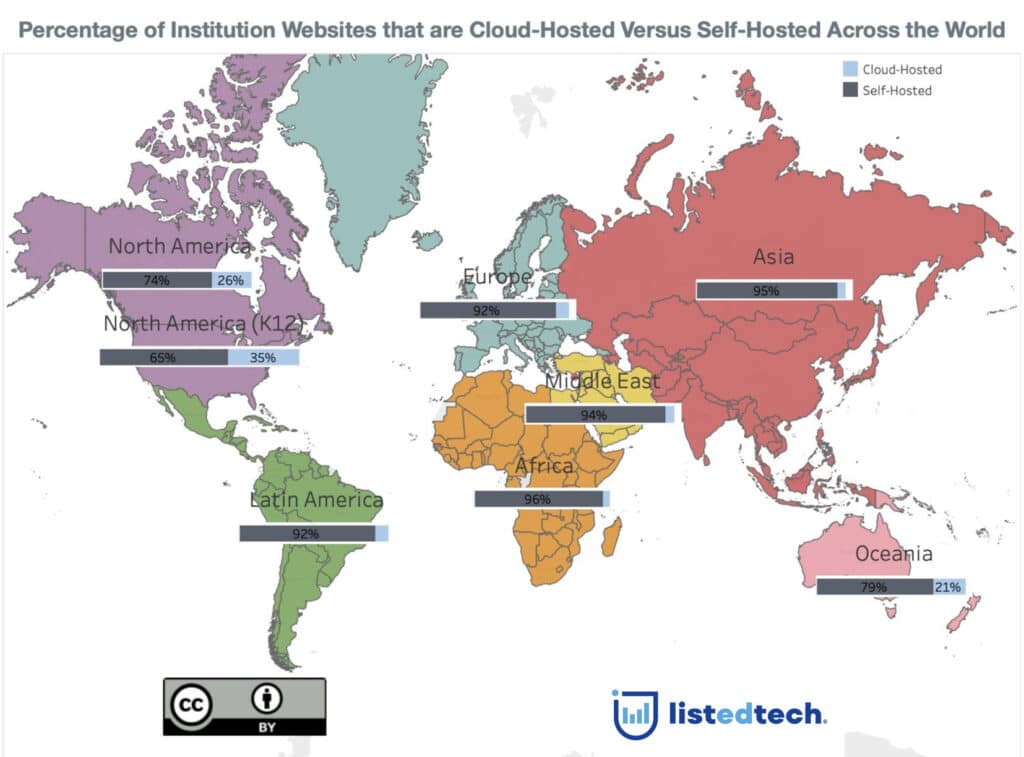
Data note: we have collected the data for this graph in August 2020.


Post navigation

Blackbaud’s Cyber-Attack
How COVID-19 Has Impacted Implementations of New Systems in HigherEd?
  • Subscribe to Our Newsletter
  • CAPTCHA image

    * All fields are required.

  • Listen to Our Podcast


  • Recent Posts

    • JAM 2026: A Different Kind of ERP Conference June 3, 2026
    • The AI Ecosystem Advantage in Higher Education May 27, 2026
    • K-12 LMS Market Update & Insights: May 2026 May 20, 2026
    • EdTech Incidents Come and Go. Responses Last Longer. May 13, 2026
    • Canvas Reimagined: Tiered Platforms and AI Strategy April 29, 2026

Stay in the know…

Blog & News
Higher Ed Student Information Systems

JAM 2026: A Different Kind of ERP Conference

Last week, I attended my first Jenzabar Annual Meeting (JAM) in Dallas, Texas. As a relatively new partner to Jenzabar, we saw this event as a chance to better understand the company, its clients, and the direction of the platform. After all, every conference has its own personality, some feel like sales rallies, while others ... JAM 2026: A Different Kind of ERP Conference  Read More
Artificial Intelligence

The AI Ecosystem Advantage in Higher Education

One of the more interesting themes emerging in AI discussions is the idea that the real transformation is not about adding AI to existing workflows. It is about redesigning how organizations operate from the ground up. In a recent article, Julie Linn Teigland argues that organizations often treat AI as a “bolt-on” tool for incremental ... The AI Ecosystem Advantage in Higher Education  Read More
K-12 Learning Management Systems Market Data

K-12 LMS Market Update & Insights: May 2026

Over the past decade, the K-12 Learning Management System (LMS) market has undergone significant consolidation and shifting user preferences. Our historical data shows that while some legacy systems have steadily declined, a clear trio of dominant platforms has emerged to capture the vast majority of the K-12 market share. Using the latest data from the ... K-12 LMS Market Update & Insights: May 2026  Read More
Footer Logo - LisTedTECH
  • Contact Us
  • Frequently Asked Questions
  • Privacy Policy
  • Terms of Use