ListedTech
  • Data Portals
    • Portal for Industry
    • Portal for Institutions
    • Webinars
  • Product Categories & Reports
  • Resources
    • Blog
    • Podcast
    • Documentation
    • Webinars
  • About Us
    • Our Story
    • Data Overview
    • Traditional IT Research vs. ListEdTech
    • In the Media
    • Contact Us

Search the website...

Go to Portal
Posted on May 2, 2021 | by Justin Ménard

Are RFPs a Good Predictor for Product Purchase?

Higher Ed
RFP Dates over Implementation Dates - LisTedTECH

Since the inception of ListEdTech, we mostly relied on web crawling to gain our knowledge about implementations in HigherEd (and K-12) for all product categories. As we want to become more efficient and versatile with our data collection, and possibly get an extra indicator of market trends, we have started, six months ago, compiling RFP data.

RFPs are not used by all HigherEd institutions, but they are mostly mandatory for public institutions in Canada and the USA. From what we know, RFPs represent about 4% of the new market implementations. In order to gain information about RFPs, we have subscribed to two companies to get the most detailed information.

With our two subscriptions in tow, we have looked at the information provided. We noticed that historical RFP data is less accurate, mostly because the original information (links, postings or whatever) can no longer be found. Also, while some RFPs bear fruit, others do not provide any valuable information or are simply not allocated to new companies.

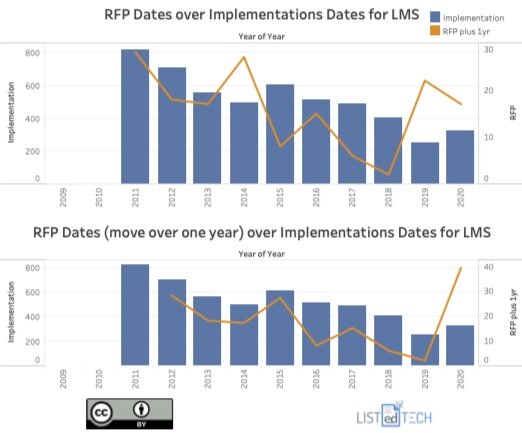
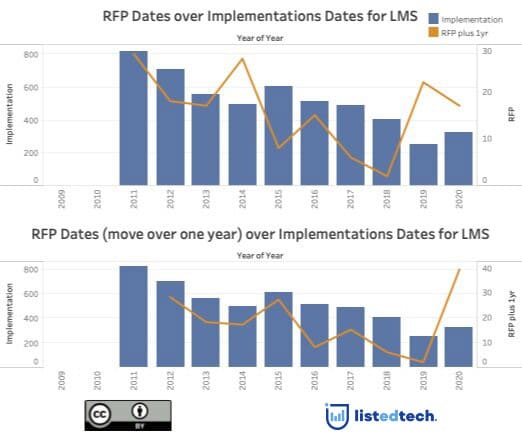
From the past six months, we have not found anything mind-blowing. This being said, we can tell that RFPs are a good predictor of product purchases. When looking at the top graph, you can see, for each year, RFP information and implementation data.

In the second graph that is also, we took the same data but moved the RFPs one year in the future. Now, the RFPs from 2015 are aligned with the implementations from 2016. As you can see, it’s scary how this is accurate.
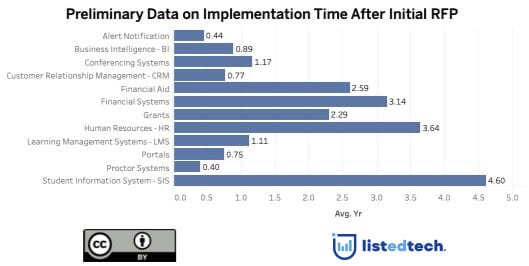
 We have done this experiment with LMS data from the past ten years, but we are now working on getting RFP data for several of our other product categories as well. With what we currently have, I can see that Financial and HR data will have on average a three-year predictor while for CRM, it is a one-year prediction. Actually, CRM prediction is just a few months less than LMS which is closer to a thirteen-month prediction. SIS has the longest with almost 5 years.

Post navigation

Cloud Nine for Ellucian
Quottly – Helping Students Graduate on Time
  • Subscribe to Our Newsletter
  • CAPTCHA image

    * All fields are required.

  • Listen to Our Podcast


  • Recent Posts

    • JAM 2026: A Different Kind of ERP Conference June 3, 2026
    • The AI Ecosystem Advantage in Higher Education May 27, 2026
    • K-12 LMS Market Update & Insights: May 2026 May 20, 2026
    • EdTech Incidents Come and Go. Responses Last Longer. May 13, 2026
    • Canvas Reimagined: Tiered Platforms and AI Strategy April 29, 2026

Stay in the know…

Blog & News
Higher Ed Student Information Systems

JAM 2026: A Different Kind of ERP Conference

Last week, I attended my first Jenzabar Annual Meeting (JAM) in Dallas, Texas. As a relatively new partner to Jenzabar, we saw this event as a chance to better understand the company, its clients, and the direction of the platform. After all, every conference has its own personality, some feel like sales rallies, while others ... JAM 2026: A Different Kind of ERP Conference  Read More
Artificial Intelligence

The AI Ecosystem Advantage in Higher Education

One of the more interesting themes emerging in AI discussions is the idea that the real transformation is not about adding AI to existing workflows. It is about redesigning how organizations operate from the ground up. In a recent article, Julie Linn Teigland argues that organizations often treat AI as a “bolt-on” tool for incremental ... The AI Ecosystem Advantage in Higher Education  Read More
K-12 Learning Management Systems Market Data

K-12 LMS Market Update & Insights: May 2026

Over the past decade, the K-12 Learning Management System (LMS) market has undergone significant consolidation and shifting user preferences. Our historical data shows that while some legacy systems have steadily declined, a clear trio of dominant platforms has emerged to capture the vast majority of the K-12 market share. Using the latest data from the ... K-12 LMS Market Update & Insights: May 2026  Read More
Footer Logo - LisTedTECH
  • Contact Us
  • Frequently Asked Questions
  • Privacy Policy
  • Terms of Use